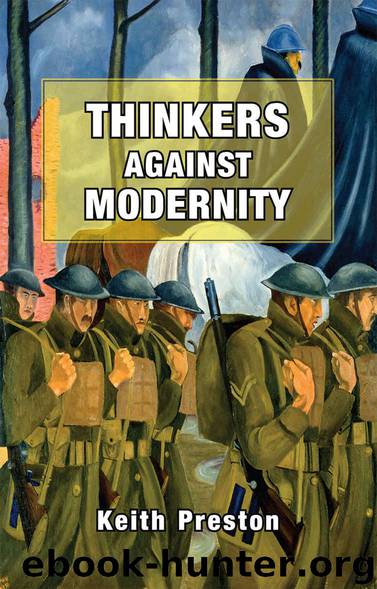
Thinkers Against Modernity by Keith Preston
Author:Keith Preston [Preston, Keith]
Language: eng
Format: epub
Publisher: Black House Publishing Ltd
Published: 2018-08-03T04:00:00+00:00
G. K. Chesterton
Neither Progressive nor Conservative: The Anti-Modernism of G. K. Chesterton
Gilbert Keith Chesterton (1874-1936) bears the distinction of being a writer who resisted virtually all of the dominant trends of his era. He lived during the late nineteenth and early twentieth century, precisely the time that modernity was fully consolidating itself within Western civilization more than a century after the apex of the Enlightenment and the French Revolution. Chesterton began his writing career as a young man and as the twentieth century was just beginning. As much as any other writer from his era, he predicted the horrors that century would entail.
A man of many talents and interests, Chesterton was a playwright, novelist, lecturer, journalist, poet, critic of literature and art, philosopher, and theologian. His work in many of these areas stands out as being among the very best of the era and continues to offer immense insight even in the present day. Among Chesterton’s circle of friends and intellectual sparring partners were such luminaries as H. G. Wells, Bertrand Russell, and George Bernard Shaw. His relationships with these men are themselves highly significant as each of them were among the leading “progressive” intellectuals of the era and fully committed to the modernist values of rationalism, secularism, and socialism. As these were all systems of thought that Chesterton adamantly opposed, it is striking that he could also count some of these figures as friends and engage them in amiable debate. It was during an era when the old liberal values of rational discourse and gentlemanly civility still prevailed, even among those who in many ways held polar opposite world views. It was before the time of the radical political polarization of modern intellectual life that began with the growth of the totalitarian movements of the early to middle twentieth century. The friendly exchanges between Chesterton and Shaw, for instance, even on topics of intense disagreement in many ways serve as a refreshing contrast to the rhetorical brutality that dominates much of today’s public discourse.
The dramatic changes that had occurred in Western society over the course of the nineteenth century had dramatically impacted the thinking of its leading intellects. The growth of industrial civilization has raised the general standards of living to levels that were hitherto not even dreamed of, and the rising incomes of the traditionally exploited industrial working class were finally allowing even the proletariat to share in at least some middle class comforts. The rise of new political ideologies such as liberalism and democracy had imparted to ordinary people political and legal rights that were previously reserved only for the nobility. Health standards also increased significantly as industrial civilization expanded and life expectancy began to grow longer. Scientific discovery and technological innovation exploded during the same era and human beings began to marvel at what they had accomplished and might be able to accomplish in the future. Religion-driven superstitions had begun to wane and the religious persecutions of the past had dwindled to near non-existence. Societies became
Download
This site does not store any files on its server. We only index and link to content provided by other sites. Please contact the content providers to delete copyright contents if any and email us, we'll remove relevant links or contents immediately.
| Anarchism | Communism & Socialism |
| Conservatism & Liberalism | Democracy |
| Fascism | Libertarianism |
| Nationalism | Radicalism |
| Utopian |
The Secret History by Donna Tartt(19103)
The Social Justice Warrior Handbook by Lisa De Pasquale(12197)
Thirteen Reasons Why by Jay Asher(8919)
This Is How You Lose Her by Junot Diaz(6894)
Weapons of Math Destruction by Cathy O'Neil(6284)
Zero to One by Peter Thiel(5808)
Beartown by Fredrik Backman(5768)
The Myth of the Strong Leader by Archie Brown(5513)
The Fire Next Time by James Baldwin(5454)
How Democracies Die by Steven Levitsky & Daniel Ziblatt(5225)
Promise Me, Dad by Joe Biden(5157)
Stone's Rules by Roger Stone(5091)
A Higher Loyalty: Truth, Lies, and Leadership by James Comey(4967)
100 Deadly Skills by Clint Emerson(4932)
Rise and Kill First by Ronen Bergman(4797)
Secrecy World by Jake Bernstein(4756)
The David Icke Guide to the Global Conspiracy (and how to end it) by David Icke(4723)
The Farm by Tom Rob Smith(4517)
The Doomsday Machine by Daniel Ellsberg(4493)
